Business Before Politics: Understanding the Shifting India US Trade Dynamics
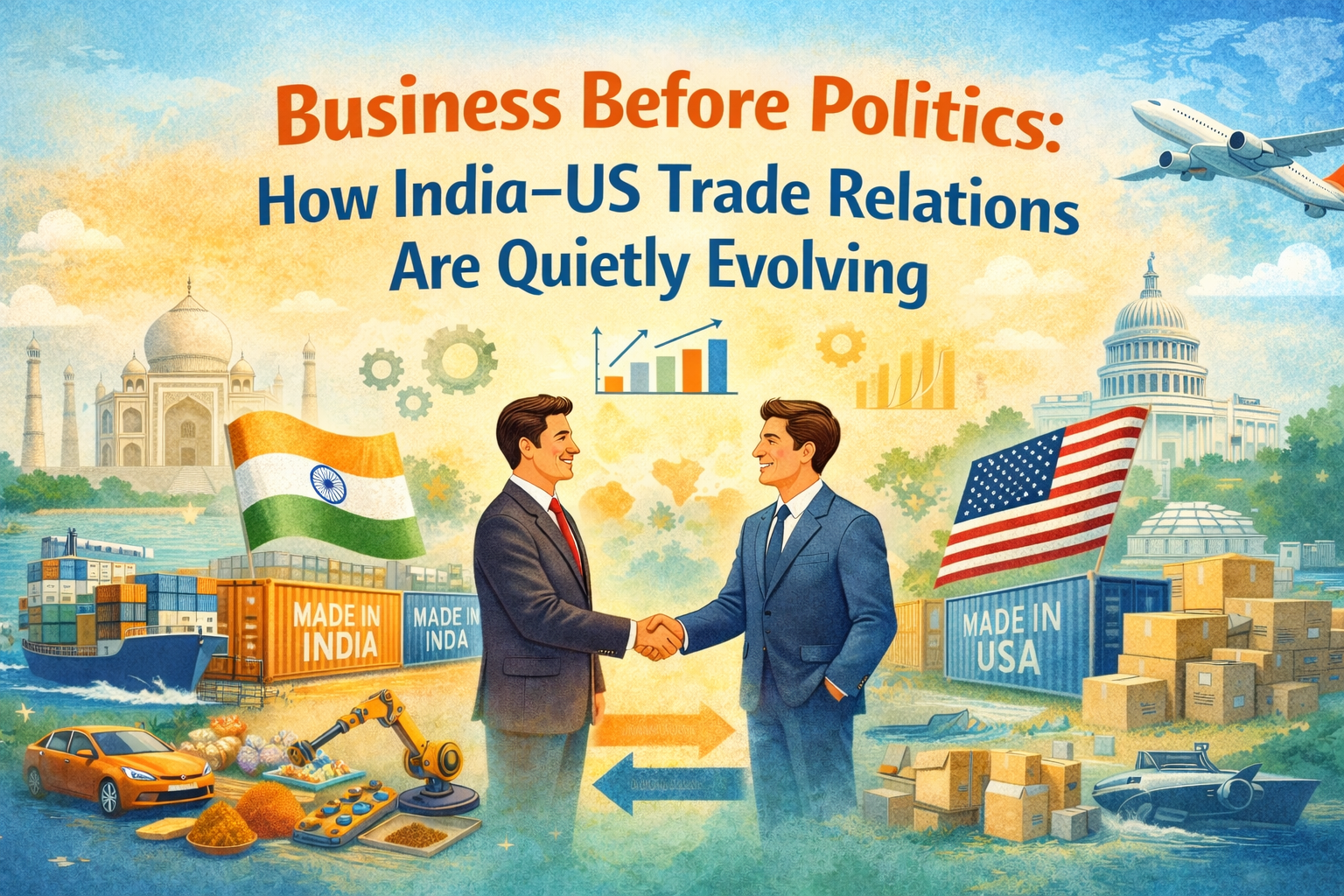
Donald Trump has long projected himself as a businessman first and a politician second. To understand his global trade approach, especially toward India, one must look at the pattern behind his decisions rather than isolated headlines. When viewed through a business lens, his strategy begins to look less like diplomacy and more like negotiation at a global scale.
For years, Trump repeatedly argued that India benefited disproportionately from trade with the United States. His core complaint was simple: American goods faced significantly higher tariffs in India, often in the range of 16 to 18 percent, while Indian goods entering the US faced tariffs closer to 3 percent. To Trump, this imbalance represented a bad deal. Like any negotiator who believes he is getting the short end of a bargain, his objective was always to rebalance the equation.
Then came the geopolitical shift that changed the energy landscape. Western sanctions on Russia reshaped global oil trade. When the Ukraine conflict escalated and sanctions tightened, Russia began offering crude oil at steep discounts to attract buyers willing to continue trade. India, being the world’s third largest oil consumer and heavily dependent on imports for roughly 89 percent of its oil needs, found itself in a difficult but practical position. Energy security is not a luxury for India. It is an economic necessity.
Cheap Russian oil quickly became a lifeline. By 2024 to 2025, India’s imports of Russian crude reportedly surged to around 35.8 percent of total oil imports. From a purely economic perspective, this move made perfect sense. When a country imports nearly nine tenths of its oil, walking away from discounted supply is not just difficult. It is potentially damaging. Lower energy costs influence everything from transportation and manufacturing to inflation and household budgets. For a developing economy managing growth and stability simultaneously, affordability matters.
However, this was not the first time India faced such pressure. In 2019, when the United States imposed sanctions on Iran, India quietly complied and stopped importing Iranian oil despite it being a long standing supplier. That episode demonstrated India’s willingness to adjust its energy partnerships when geopolitical pressure became unavoidable.
Now, the conversation appears to be shifting again. A potential trade understanding between the United States and India is being discussed in terms that sound remarkably transactional. Reduced tariffs, increased imports, and large purchase commitments are at the center of the discussion. Reports and speculation suggest a scenario in which tariffs on American products could drop significantly, possibly even to zero in some sectors, while India increases its imports of US goods including agricultural products on a massive scale that could reach hundreds of billions of dollars.
In return, tariffs that were once as high as 50 percent might fall to around 18 percent. On paper, this looks like a classic deal. Concessions exchanged for access and pressure exchanged for partnership. In the short term, Indian businesses that rely on trade with the US could benefit from reduced barriers and smoother access to American markets. Investors often welcome predictability and trade agreements create precisely that.
But trade deals are rarely judged only by their immediate benefits. The long term consequences often reveal the deeper impact. Increased imports of foreign goods, especially agricultural products, can create competitive pressure on domestic industries. Lower tariffs can stimulate trade but they can also expose local producers to stronger global competition before they are fully prepared.
This tension between short term relief and long term resilience is at the heart of every major trade negotiation. For policymakers, the challenge is balancing diplomatic relationships with economic independence. For businesses, the question is whether new opportunities will outweigh the risks of increased competition.
Public perception often depends on political narratives. Supporters may frame such agreements as diplomatic victories and evidence of global partnership. Critics may view them as compromises that could weaken domestic industries over time. Both perspectives can coexist because trade deals are rarely simple victories or defeats. They are complex exchanges shaped by global power dynamics, economic necessity, and strategic compromise.
Ultimately, the story unfolding here is not just about tariffs or oil imports. It is about how nations negotiate power in an interconnected world. It is about how energy security, trade policy, and geopolitical alliances intersect in ways that shape the future of economies.
Whether this evolving relationship becomes a long term partnership or remains a temporary alignment will depend on how the next few years unfold. For now, it serves as a reminder that in global politics, as in business, every deal carries both opportunity and risk and the true outcome is often visible only with time.

Dr. Neeraj Tiwari, PhD
I write about business leadership, workplace culture, and professional self-improvement-ideas that help individuals grow with clarity, lead with confidence, and build meaningful, successful careers.